
What No One Tells You About Hormone Balance Supplements and Your Cycle
Walk into any pharmacy or scroll through social media, and you will find shelves — and feeds — packed with products promising to "balance your hormones." Adaptogenic blends, DIM supplements, seed cycling kits, and herbal capsules all claim to regulate estrogen, ease PMS, and restore your body to some idealized equilibrium. But do they work? The answer is more complicated than the marketing suggests — and understanding it can save you money, frustration, and potentially your health.
This article breaks down what "hormone balance" actually means scientifically, which supplements have credible research behind them, and when you should be talking to a doctor instead of reaching for a bottle.
What Does "Hormone Balance" Actually Mean?
The phrase "hormone balance" does not correspond to a specific medical diagnosis or measurable lab value. Hormones like estrogen, progesterone, testosterone, cortisol, and insulin are in constant flux — fluctuating daily, across your menstrual cycle, and over the course of your lifetime. There is no single "balanced" hormonal state that every person should maintain.
Endocrinologists describe hormonal health not as a fixed balance, but as a dynamic system that responds to sleep, stress, nutrition, exercise, and underlying health conditions. When supplement companies use the word "balance," they are often using an undefined term that sounds scientific but is not clinically measurable.
Why the Marketing Language Is Misleading
Supplement manufacturers are not required by the U.S. Food and Drug Administration (FDA) to prove their products work before selling them. Under the Dietary Supplement Health and Education Act (DSHEA) of 1994, supplements are regulated more like food than medicine — meaning companies can market products with vague structure/function claims ("supports hormonal health") without clinical proof. A 2023 report from the Government Accountability Office found that the FDA had taken formal action against fewer than 1% of supplement companies for making unsupported claims in the previous decade.
Read Related Article: Why You Feel More Sensitive During the Luteal Phase of Your Menstrual Cycle

Which "Hormone Balance" Supplements Have Actual Research Behind Them?
Not all supplements are created equal. A small number of ingredients have genuine peer-reviewed research supporting their use for specific hormone-related conditions — though the evidence is often modest and the results are condition-specific, not universally applicable.
Vitex (Chasteberry) for PMS and Luteal Phase Symptoms
Vitex agnus-castus is one of the most studied herbal supplements for menstrual cycle support. A systematic review published in the Journal of Alternative and Complementary Medicine found that Vitex was more effective than placebo in reducing PMS symptoms including irritability, mood changes, headache, and breast tenderness. The proposed mechanism involves dopaminergic activity that indirectly reduces prolactin, which can normalize luteal phase progesterone levels. However, Vitex is not appropriate for everyone — it can interact with hormonal contraceptives and dopamine-related medications.
Magnesium for PMS-Related Symptoms
Magnesium deficiency is common — an estimated 48% of Americans do not consume adequate dietary magnesium according to the National Institutes of Health Office of Dietary Supplements. Several randomized controlled trials have shown that magnesium supplementation can reduce PMS-related symptoms including cramping, mood disturbances, and fluid retention. It works through multiple pathways: it modulates prostaglandin synthesis (which drives cramping), supports the nervous system's stress response, and assists with blood sugar regulation.
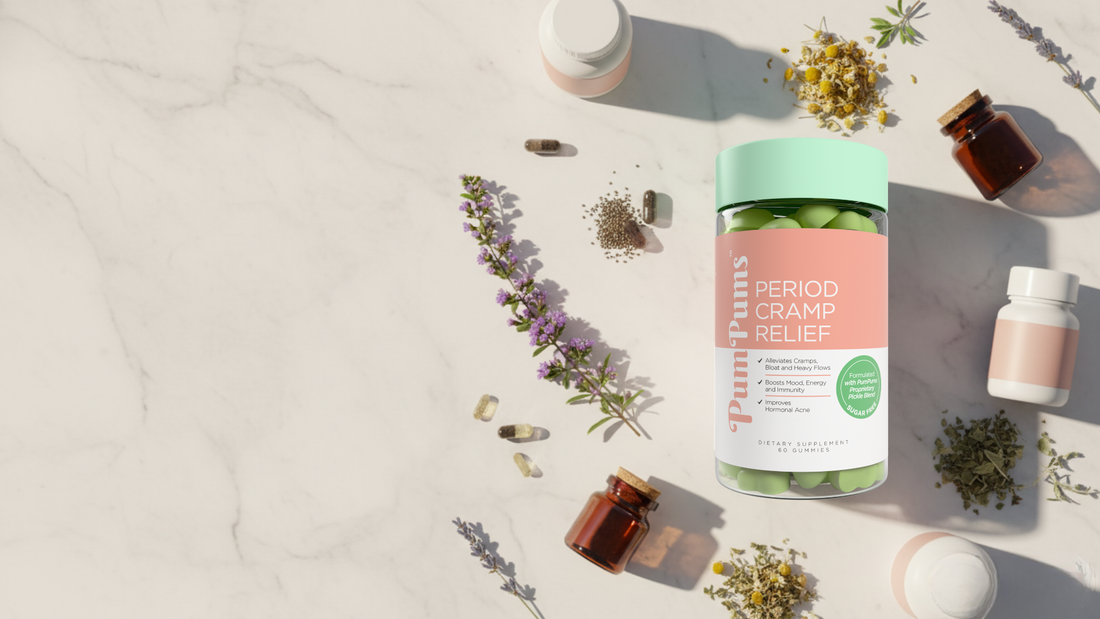
If menstrual cramps are a concern for you, PumPums Period Cramp Relief is formulated with research-backed ingredients to address cycle-related discomfort — and clearly explains what each ingredient is intended to do and why.
DIM (Diindolylmethane) and Estrogen Metabolism
DIM is a compound derived from cruciferous vegetables that influences how the body metabolizes estrogen. Some research, including studies cited by the National Cancer Institute, suggests DIM may promote the metabolism of estrogen into "weaker" rather than more proliferative metabolites. However, the research on DIM as a supplement in humans is still preliminary, and its clinical significance for healthy women without estrogen metabolism disorders has not been well-established. Taking high-dose DIM without medical oversight may not be appropriate, particularly for those on hormonal medications.
Myo-Inositol for PCOS
For women with polycystic ovary syndrome (PCOS), myo-inositol is one of the more promising research-backed options. PCOS affects approximately 1 in 10 women of reproductive age, according to the Office on Women's Health. A 2019 meta-analysis in the European Review for Medical and Pharmacological Sciences found that myo-inositol improved insulin sensitivity, reduced androgen levels, and helped restore menstrual regularity in women with PCOS. Importantly, this research applies specifically to women with PCOS — not to hormonal imbalances broadly.
Read Related Article: What Causes Irregular Periods and When You Should Get Help for Menstrual Changes
What Supplements Lack Solid Evidence?
Many popular products on the market — including seed cycling protocols, generic "hormone support" blends, and adaptogen-heavy formulas — have little to no clinical research demonstrating their effectiveness for hormonal conditions in humans.
Seed Cycling
Seed cycling involves eating specific seeds (flax, pumpkin, sesame, sunflower) during different phases of the menstrual cycle to supposedly support estrogen and progesterone levels. While seeds contain beneficial nutrients like zinc, selenium, and lignans, no peer-reviewed clinical trials have validated seed cycling as an effective protocol for hormonal regulation. The concept is nutritionally harmless but unsupported as a therapeutic approach.
Generic Adaptogen Blends
Ashwagandha, rhodiola, maca, and similar adaptogens are frequently marketed as hormone balancers. Some of these, particularly ashwagandha, have reasonable research supporting their role in stress response and cortisol regulation. However, there is a large gap between "may reduce stress hormones" and "balances your reproductive hormones." Many products blend these ingredients at doses too low to be clinically meaningful, and the marketing often overclaims relative to the evidence.
When Should You See a Doctor Instead of Taking a Supplement?
Supplements can complement care, but they are not a substitute for medical evaluation when real hormonal disorders are present. You should consult a healthcare provider rather than self-treating with supplements if you experience any of the following:
Irregular or absent periods for more than three consecutive months Irregular cycles that persist beyond typical cycle variation can signal conditions like PCOS, hypothalamic amenorrhea, premature ovarian insufficiency, or thyroid dysfunction. These require proper diagnosis, not a supplement.
Severe PMS or PMDD (Premenstrual Dysphoric Disorder) PMDD affects approximately 3–8% of women of reproductive age and is classified as a depressive disorder in the DSM-5. It responds well to evidence-based treatments including SSRIs and hormonal therapies — not herbal supplements alone.
Symptoms of perimenopause or menopause Hot flashes, night sweats, vaginal dryness, and cognitive changes associated with perimenopause have researched medical treatments. Hormone replacement therapy (HRT) remains one of the most effective options and has been significantly rehabilitated by updated research over the past decade.
Read Related Article: How Hormones Affect Mood Before Your Period
How to Evaluate a Hormone Supplement Before Buying It
If you are considering a supplement, applying a few basic filters can help you avoid wasting money on products that are unlikely to help.
Check for Third-Party Testing
Look for certifications from organizations like NSF International, USP (United States Pharmacopeia), or Informed Sport. These indicate that the product has been independently tested for label accuracy and contaminants. The ConsumerLab.com database is also a useful resource for checking whether specific supplement brands have passed quality testing.
Match the Ingredient to a Specific Condition
The strongest supplement evidence tends to be condition-specific. Myo-inositol is studied in PCOS. Vitex is studied in PMS. Magnesium is studied in dysmenorrhea. If a product claims to work for all hormonal concerns at once, that is a red flag. Ask whether the research behind any given ingredient applies to your specific situation, not just to "hormone balance" broadly.
Look at the Doses
Many formulas include ingredients at doses far below what was used in clinical research. A product with 50mg of magnesium, for example, is not going to produce the same effects as the 300–400mg doses used in clinical trials. Always compare label doses to the research doses for any ingredient you are evaluating.
The Bottom Line on Hormone Balance Supplements
The supplement industry has capitalized on a genuine and common frustration: that hormonal symptoms are frequently dismissed or undertreated in conventional medicine. That frustration is valid. But a loosely defined concept like "hormone balance" packaged into a capsule does not automatically translate into a meaningful solution.
Some supplements — magnesium, Vitex, and myo-inositol in particular — have earned a degree of scientific credibility for specific conditions. Many others rely on marketing language that does not hold up to scrutiny. The most important thing you can do for your hormonal health is to understand what your symptoms actually indicate, seek appropriate medical evaluation when needed, and approach supplement claims with the same critical eye you would apply to any health product.
For more science-grounded content on menstrual health, cycle symptoms, and what actually works, visit the PumPums Blog. And if you are looking for targeted relief from period cramps specifically, PumPums Period Cramp Relief offers a transparent, ingredient-forward formula designed with your cycle in mind.


