
Compartir
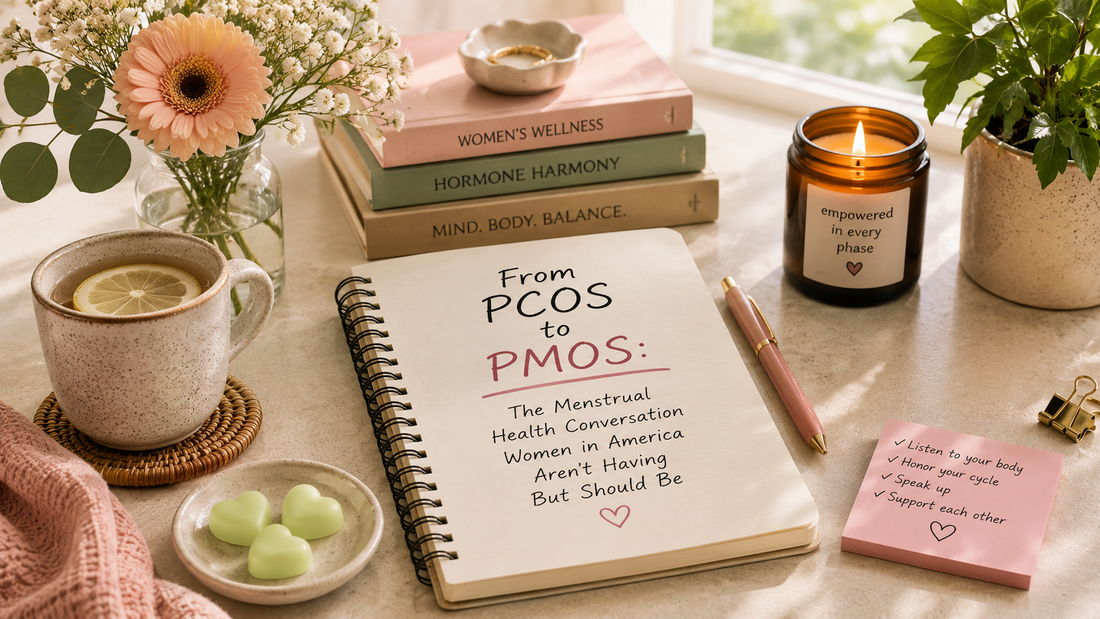
There's a term making the rounds in women's wellness spaces across the US: PMOS (Pre-Menstrual Optimization Syndrome). It's not a clinical diagnosis. It's not in any textbook. But for the growing number of women who have moved beyond just "dealing with their period," it captures something real — a decision to stop treating your menstrual cycle like a monthly inconvenience and start treating it like the health signal it actually is.
We talk a lot about PCOS (Polycystic Ovary Syndrome), which affects roughly 1 in 10 women of reproductive age in the United States and gets significant clinical attention. But the broader conversation about everyday menstrual health — the bloating, the brain fog, the bone-deep fatigue, the mood swings that roll in like weather — that conversation is still largely happening in whispers, in DMs, in comment sections at 11pm.
It's time to bring it out in the open.
The Gap Between "Normal" and "Fine"
If you've ever described a symptom to a doctor and been told some version of "that's just part of having a period" — you're not alone. It's one of the most common experiences women report when seeking help for menstrual health concerns. Symptoms get normalized. Dismissed. Managed with a prescription and a shrug.
But there's a difference between something being common and something being unavoidable.
Period cramps affect more than 80% of women at some point in their lives. Severe cramping — the kind that cancels plans, disrupts work, and sends women to urgent care — affects up to 20%. Premenstrual syndrome (PMS) in some form impacts an estimated 90% of menstruating women. PMDD (Premenstrual Dysphoric Disorder), its more severe clinical cousin, affects 3–8% and is still widely underdiagnosed.
These are not fringe statistics. These are the lived realities of millions of women across the country, many of whom have been told their experience is simply the cost of being a woman.
That framing needs to change.
What Is PMOS and Why Does It Matter
PMOS stands for Pre-Menstrual Optimization Syndrome — and yes, the name is intentional. It mirrors PCOS in structure because the comparison is the point.
PCOS is reactive by necessity. It describes a condition already present, a set of symptoms already disrupting life, a diagnosis already earned through suffering. The medical system responds to it after the fact.
PMOS flips that entirely. It's not a diagnosis. It's a framework — a way of thinking about your menstrual cycle that starts before things go wrong. Instead of waiting for cramps to reach for a heating pad, you support your body's inflammatory response all cycle long. Instead of white-knuckling through the luteal phase every month, you understand why progesterone is dropping and what your system needs to handle that transition better. Instead of attributing your mood, your skin, your sleep, and your appetite to personal failings, you recognize them as hormonal signals that deserve a response.
The reason PMOS is gaining traction is simple: women are tired of being reactive about their own health.
For generations, menstrual symptoms were treated as background noise — inconvenient but inevitable, personal but unimportant. Women were expected to manage quietly and carry on. The medical response to period pain has historically been underwhelming, and the cultural response has been worse. "It's just PMS" became a way to dismiss real, recurring, cyclical suffering that affects nearly every menstruating woman on the planet.
PMOS says: we know better now. We know what happens hormonally across each phase. We know which nutrients are depleted during menstruation. We know how cortisol interacts with progesterone. We know that the week before your period isn't just uncomfortable — it's physiologically demanding. And that knowledge creates an obligation to act on it, not just endure it.
The shift from PCOS awareness to PMOS awareness isn't about minimizing medical conditions. It's about expanding the conversation to include the millions of women who don't have a diagnosis but still struggle every month — and who deserve better answers than "that's normal."
What's Actually Happening Inside Your Cycle Every Month
Understanding why the menstrual cycle creates such wide-ranging symptoms starts with understanding what the cycle actually is — not just the bleeding part, but the whole hormonal arc.
The menstrual cycle has four phases:
-
Menstrual (Days 1–5) Estrogen and progesterone are at their lowest. The uterine lining sheds. Prostaglandins — hormone-like compounds that trigger uterine contractions — are released, causing cramping. For women with elevated prostaglandin activity, this phase can mean intense pain, nausea, diarrhea, and debilitating fatigue.
-
Follicular (Days 6–13) Estrogen begins to rise. Energy, focus, and mood typically improve. For many women, this is the "good week" — the one where they feel like themselves again. This phase is rarely discussed, because there's less to complain about.
-
Ovulatory (Around Day 14) Estrogen peaks, testosterone briefly surges, and many women feel their most energized, social, and confident. Ovulation pain (mittelschmerz) affects some women and is often mistaken for something more serious.
-
Luteal (Days 15–28) This is where it gets complex. Progesterone rises after ovulation, then drops sharply in the days before menstruation begins, taking estrogen with it. This hormonal withdrawal is behind almost every PMS symptom you can name: mood swings, irritability, anxiety, cravings, bloating, breast tenderness, hormonal acne, fatigue, and disrupted sleep. For women with already-imbalanced hormone ratios, this phase can feel like a completely different existence.
Understanding this arc is foundational. When you know why you feel the way you feel at different points in your cycle, it stops feeling like random suffering and starts feeling like information.
Read More: Natural Hormone Support for Women 30s
Why Periods Cause Fatigue, Mood Swings, and So Much More
One of the most Googled questions in women's health: why do periods cause fatigue and mood swings? The short answer is that it's not one thing — it's a cascade.
Fatigue during your period is driven by several overlapping factors. Blood loss depletes iron. Low estrogen reduces serotonin production. Disrupted sleep from cramping and temperature changes compounds exhaustion. And the inflammatory response to prostaglandins creates the same kind of full-system tiredness you feel when you're fighting an illness.
Mood swings and irritability in the luteal phase are tied to the sharp decline in both estrogen and progesterone, both of which modulate serotonin, GABA, and dopamine activity in the brain. Lower levels of these neurotransmitter regulators mean less emotional buffering. Things that would normally roll off you suddenly don't. Frustration spikes faster. Sadness arrives without a clear cause. This is not a character flaw. It's neurochemistry.
Bloating is driven by a combination of water retention (estrogen promotes sodium retention), slowed gut motility in the luteal phase, and shifts in the gut microbiome that can increase gas production.
Hormonal acne follows a predictable pattern for most women — flaring in the days before menstruation as testosterone becomes relatively more dominant and sebum production increases.
Sleep disruption is one of the most underacknowledged cycle symptoms. Progesterone has sedative properties when it's stable, but the sharp premenstrual drop — combined with elevated nighttime cortisol and increased core temperature — actively interferes with sleep quality in ways most women attribute to stress rather than their cycle.
All of these symptoms share a common thread: hormonal fluctuation. And hormonal fluctuation is, to varying degrees, manageable.
The Role of Stress and Why It Makes Everything Worse
Here's the piece of the puzzle that doesn't get enough attention: stress and the menstrual cycle are in constant conversation with each other.
Cortisol (your primary stress hormone) is produced using the same precursor molecules as progesterone. When chronic stress is high, your system can essentially "steal" from progesterone production to keep up with cortisol demand. The result is what researchers sometimes call progesterone deficiency, and it can amplify every luteal phase symptom you already experience.
Stress also disrupts the HPG axis (hypothalamic-pituitary-gonadal axis), the hormonal communication system responsible for regulating your cycle. Chronic stress is one of the leading causes of cycle irregularities — late periods, skipped periods, shortened luteal phases, and worsened PMS — in women who are otherwise reproductively healthy.
In a country where burnout among women ages 25–44 is at an all-time high, this connection matters. Managing your menstrual health is not separate from managing your mental health and nervous system. They are the same conversation.
The Awareness Gap: What Women Are Searching for vs. What They're Being Told
Across the United States, searches for hormone balance support, natural period relief, menstrual health supplements, and what helps PMS symptoms naturally have grown year over year. Women are clearly looking for answers and educating themselves in the absence of adequate clinical conversations.
And yet the medical system still tends to offer two responses to menstrual health concerns: hormonal contraception, or "try ibuprofen." Both have their place. Neither is a complete answer.
The growing interest in women's hormone health reflects something broader than a wellness trend. It reflects a generation of women who have decided that understanding their own biology is non-negotiable — that tracking your cycle, knowing your phases, recognizing your patterns, and supporting yourself with consistent nutrition and self-care is not excessive. It's intelligent.
The shift from PCOS (managing a diagnosed condition) to PMOS (proactively optimizing cycle health) is a mindset shift. And it's happening across income levels, age groups, and every region of the country.
What a Proactive Menstrual Wellness Approach Actually Looks Like
Cycle awareness doesn't require expensive testing or a functional medicine practitioner, though both can help. At the most foundational level, it looks like this:
Track your cycle. Apps like Clue, Natural Cycles, or even a simple notebook help you identify your personal patterns — when your energy dips, when your mood shifts, when symptoms reliably appear. Pattern recognition is where understanding begins.
Align food with your phases. In the follicular phase, your system handles higher-intensity nutrition well. In the luteal phase, blood sugar stability becomes critical — erratic eating worsens mood swings, cravings, and energy crashes. Prioritize iron-rich foods during and after menstruation. Increase fiber to support estrogen clearance through the gut.
Take sleep seriously, especially in the luteal phase. This isn't just recovery; it's hormonal regulation. Sleep deprivation raises cortisol, suppresses progesterone, and worsens every PMS symptom on the list. Creating a consistent pre-sleep routine that accounts for how your sleep architecture shifts across your cycle is one of the highest-leverage things you can do.
Support your nervous system. Stress management isn't optional for menstrual health — it's foundational. Breathwork, therapy, boundaries, rest. Whatever brings cortisol down consistently matters.
Consider what your daily nutrition is missing. Magnesium deficiency is pervasive among American women and directly linked to worsened cramping, poor sleep, and heightened anxiety. Vitamin B6 is critical for serotonin production. Vitamin D affects hormonal signaling at the cellular level. These aren't exotic interventions — they're foundational nutrients most women aren't getting consistently from diet alone.
PumPums Daily Cycle Essentials was built around exactly this nutritional foundation — not as a cure, not as a quick fix, but as a daily period care essential designed to fill the gaps that make cycles harder than they need to be. If you're building a more intentional approach to your menstrual wellness, it's worth knowing what's in your corner.
Read More: PumPums™ vs Traditional Period Care
The Conversation We Owe Ourselves
The shift from PCOS to PMOS isn't about replacing medical care with wellness products. It's about raising the baseline of what women expect for themselves — that their cycle be understood, not just survived.
Every woman deserves to know why she feels what she feels at different points in her month. Every woman deserves a healthcare system that takes her symptoms seriously. And every woman deserves access to the nutritional and lifestyle tools that can genuinely support her hormonal health — not as a luxury, but as a baseline.
The women searching for answers at midnight, the ones trading tips in comment sections, the ones who've been told their pain is normal one too many times — they're not being dramatic. They're advocating for themselves in the absence of better options.
That's where awareness starts. With naming it, understanding it, and refusing to accept that suffering is the default.


