
Compartir
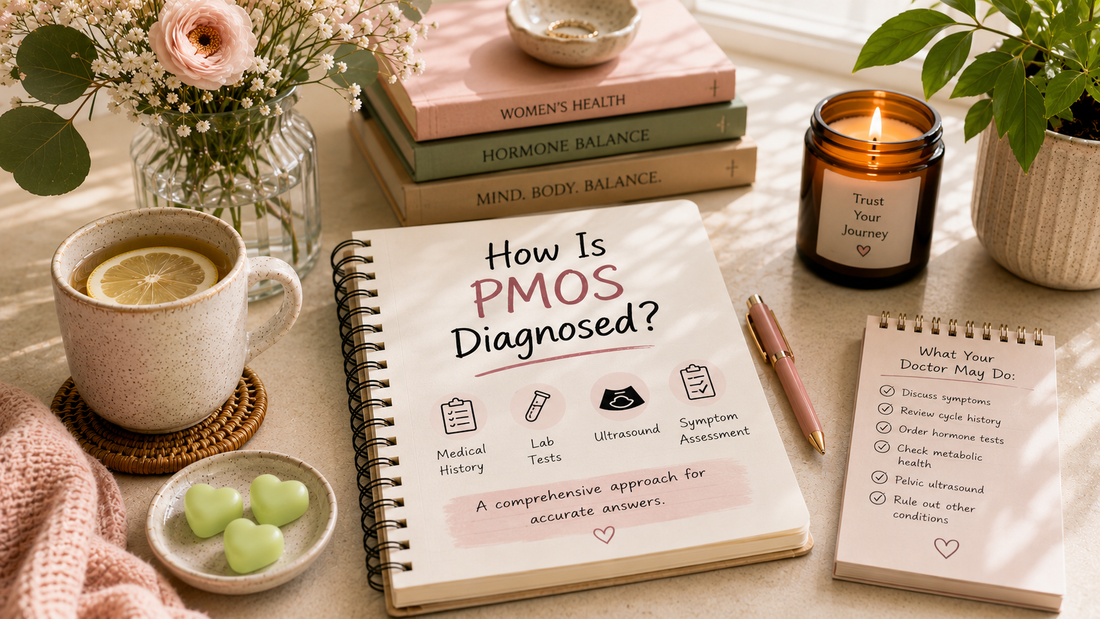
How is PMOS diagnosed? It's one of the most commonly searched questions — and one of the most commonly mishandled by the medical system.
PMOS (Polyendocrine Metabolic Ovarian Syndrome, formerly PCOS) affects an estimated 1 in 8 women. Yet on average, women wait 2–3 years and see multiple doctors before receiving an accurate diagnosis. Many are dismissed after a single ultrasound that looks "normal." Others are told their symptoms don't fit, or that their bloodwork is "fine" — without the right panels even being ordered.
Understanding how PMOS is actually diagnosed gives you the tools to advocate for yourself and get the answers you deserve.
What Doctors Use to Diagnose PMOS
PMOS is diagnosed when a patient meets at least 2 of the following 3 criteria, known as the Rotterdam Criteria:
- Elevated androgens — either measured on a blood test (high testosterone, DHEA-S) or visible in symptoms like hirsutism (unwanted facial/body hair), persistent hormonal acne, or scalp hair thinning
- Irregular or absent menstrual cycles — typically defined as fewer than 8 periods per year, cycles longer than 35 days, or complete absence of periods (amenorrhea)
- Elevated AMH or polyfollicular ovaries — detected via blood test (anti-Müllerian hormone) or pelvic ultrasound showing 20+ follicles per ovary or increased ovarian volume
You do not need all three criteria. You only need two.
This is why an ultrasound alone can never diagnose or rule out PMOS. It covers only one of the three criteria — and a "normal" ultrasound means nothing if elevated androgens and irregular cycles are both present.
The Rotterdam Criteria Explained
The Rotterdam Criteria have been the international diagnostic standard since 2003 and remain in place under the new PMOS name.
Criterion 1: Elevated Androgens
Androgens are hormones like testosterone and DHEA-S that are present in all women but elevated in PMOS. Elevated androgens can be confirmed two ways:
- Biochemical (blood test): Your doctor measures total testosterone, free testosterone, and/or DHEA-S. Many labs set reference ranges that are too broad, so it helps to request free testosterone specifically — it's a more sensitive marker.
- Clinical (visible symptoms): Hirsutism (dark, coarse hair on the upper lip, chin, chest, abdomen, or inner thighs), persistent acne (particularly along the jawline and lower face), and androgenic alopecia (thinning at the crown or temples) all qualify. These symptoms are scored using the Ferriman-Gallwey scale for hirsutism.
Read More: Is Period Acne Different From Regular Acne?
Criterion 2: Irregular or Absent Cycles
Cycle irregularity is typically defined as:
- Fewer than 8 menstrual cycles per year
- Cycles consistently shorter than 21 days or longer than 35 days
- No period for 90+ days (amenorrhea)
- It's important to note that cycle regularity alone doesn't confirm or rule out PMOS. Some women with PMOS have regular cycles and still meet the other two criteria (this is called Phenotype C — more on this below).
Read More: What Causes Irregular Periods
Criterion 3: Elevated AMH or Polyfollicular Ovaries
AMH (anti-Müllerian hormone) is a blood test that reflects the number of developing follicles in your ovaries. In women with PMOS, AMH levels are typically 2–4 times higher than average. AMH testing is now preferred over ultrasound in many clinical guidelines because it's more objective and doesn't require a transvaginal probe.
Ultrasound findings that qualify: 20 or more follicles per ovary (measuring 2–9mm) or total ovarian volume greater than 10mL. The 2023 guidelines updated the follicle threshold from 12 to 20, which means many older "borderline" diagnoses should be revisited.
What Blood Tests Should Be Done for PMOS?
A comprehensive PMOS workup should include more than androgens alone. Ask your doctor to order:
Core PMOS panel:
- Total testosterone and free testosterone
- DHEA-S
- LH (luteinizing hormone) and FSH (follicle-stimulating hormone) — LH:FSH ratio is often elevated in PMOS
- AMH (anti-Müllerian hormone)
- Fasting insulin and fasting glucose — to assess insulin resistance
- HbA1c — longer-term blood sugar average
Commonly missed but important:
- Thyroid panel (TSH, free T3, free T4) — thyroid conditions mimic PMOS and must be ruled out
- Prolactin — elevated prolactin can cause cycle irregularity without PMOS
- Vitamin D — deficiency is extremely common in PMOS and affects insulin sensitivity
- Iron and ferritin — especially important if periods are heavy or hair loss is present
Ruling out other conditions:
- 17-hydroxyprogesterone (17-OHP) — to rule out congenital adrenal hyperplasia, which looks like PMOS
- Cortisol — to rule out Cushing's syndrome
Why So Many Women Are Misdiagnosed
One of the most common diagnostic failures in PMOS care is the "just do an ultrasound" approach.
Here's what often happens: A woman mentions irregular periods or acne. Her doctor orders a pelvic ultrasound. The ultrasound shows no cysts (or fewer than the outdated threshold of 12 follicles). She's told "everything looks normal." She leaves without a diagnosis, without answers, and often feeling gaslit.
This is a fundamental misunderstanding of how PMOS works. The condition is not primarily defined by cysts — it's defined by hormonal and metabolic dysfunction. An ultrasound can confirm Criterion 3, but it cannot evaluate Criterion 1 or Criterion 2. And because only 2 of 3 criteria are required, a normal ultrasound means absolutely nothing if elevated androgens and irregular cycles are present.
Additionally, the updated follicle threshold (20 per ovary, revised in 2023) means women assessed before this update may have been incorrectly told their ultrasound was "clear."
Who Should Diagnose PMOS?
Gynecologist: Your first point of contact. A knowledgeable gynecologist can diagnose PMOS and manage most presentations, especially milder cases.
Endocrinologist or Reproductive Endocrinologist (RE): If your symptoms are more complex — particularly if fertility is a concern, insulin resistance is significant, or initial bloodwork is inconclusive — an RE or endocrinologist is better equipped to manage the metabolic and hormonal dimensions of PMOS.
What to do if you're being dismissed: Ask for a referral. Request the specific blood tests listed above. If your doctor won't order them, seek a second opinion. You are entitled to a thorough evaluation.
The PMOS Phenotypes: Why Your Diagnosis May Look Different From Someone Else's
Because PMOS only requires 2 of 3 criteria, four distinct presentations (phenotypes) exist:
| Phenotype | Androgens | Irregular Cycles | AMH/Follicles | Notes |
| A (Classic Full) | ✓ | ✓ | ✓ | Highest metabolic risk |
| B (Classic No Follicular) | ✓ | ✓ | ✗ | Ultrasound looks "normal" — most missed |
| C (Ovulatory) | ✓ | ✗ | ✓ | Regular cycles — often dismissed |
| D (Non-Androgenic) | ✗ | ✓ | ✓ | Normal androgens — mildest presentation |
Phenotype B and C are where most diagnostic failures occur — precisely because either the ultrasound or the cycle appears normal, so less thorough practitioners stop looking.
Read More: From PCOS to PMOS: The Complete Guide


