
Compartir
There's a version of motherhood nobody puts on the greeting cards. It's the one where you're lying awake at 1 a.m. running through tomorrow's schedule in your head. Where you've been touched, needed, and asked questions all day and have nothing left by evening. Where your period is late, heavier than usual, or more painful than you ever remember it being before kids.
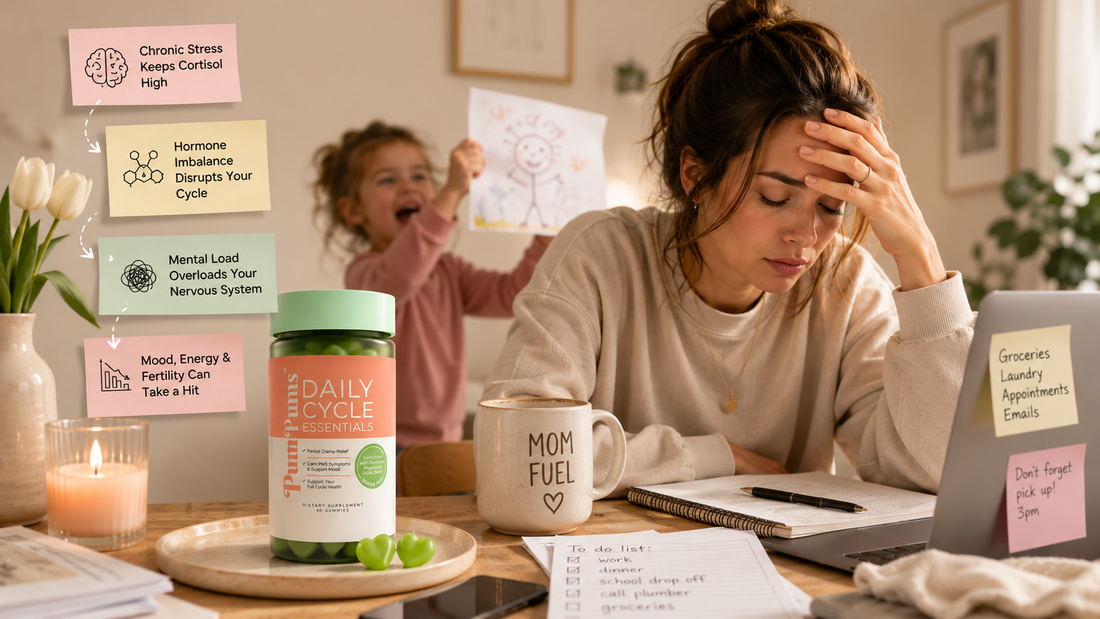
If that sounds familiar, it's not a coincidence. The relentless mental and physical load of motherhood creates a chronic stress environment in the body that directly interferes with hormone health, menstrual cycle regularity, and the way you experience PMS every single month.
And the hardest part? Most moms are so busy managing everything else that their own cycle health is the last thing on the list.
The Connection Between Stress and Your Menstrual Cycle
Stress and your menstrual cycle are far more intertwined than most women realize. The hormonal system that governs your cycle, known as the hypothalamic-pituitary-ovarian (HPO) axis, is directly sensitive to the stress hormone cortisol. When cortisol stays elevated for long periods, it sends signals that interfere with the normal hormonal rhythm your cycle depends on.
Here's what that looks like in practice:
High cortisol can suppress ovulation. When your body perceives ongoing stress, it prioritizes survival over reproduction. This can delay or suppress ovulation entirely, which shifts the timing of your entire cycle and can lead to cycle irregularities that feel confusing and unpredictable.
Cortisol competes with progesterone. Both cortisol and progesterone are made from the same precursor hormone (pregnenolone). Under chronic stress, the body prioritizes cortisol production, leaving less available for progesterone. Low progesterone means a shortened or disrupted luteal phase, worsened PMS symptoms, heavier periods, and heightened emotional sensitivity.
Stress worsens inflammation. Chronic stress increases systemic inflammation, which amplifies the prostaglandin activity responsible for period cramps. This is a major reason why moms, especially those in high-demand seasons of parenting, often notice their cramps getting more intense, not less.
Sleep deprivation compounds everything. Broken sleep from young children, night wakings, or anxiety-driven insomnia lowers the body's ability to regulate cortisol the next day. Over time, poor sleep and high cortisol create a feedback loop that disrupts hormone balance at every phase of the cycle.
Read More: Why Do Period Symptoms Change Every Month?
How Motherhood Stress Shows Up in Your Cycle
You might be experiencing the cortisol-hormone connection already without realizing it. Some of the most common ways chronic mom stress shows up in menstrual health include:
- Cycle irregularities, including late, early, or skipped periods
- Heavier or more painful periods than before having children
- Worsening PMS symptoms, especially mood swings, irritability, and anxiety
- Increased bloating during the luteal phase and menstruation
- Hormonal acne that flares in the week before your period
- Crushing fatigue that goes beyond normal tiredness
- Intense cravings for sugar and carbohydrates driven by blood sugar and serotonin disruption
- Poor sleep even when you finally have the opportunity to rest
- Low energy throughout the month, not just during your period
These aren't signs that something is permanently broken. They're signs that your body is responding to an environment of ongoing stress, and that your hormones need consistent, intentional support to find their rhythm again.
The Mental Load Is a Hormone Disruptor Nobody Talks About
The term "mental load" describes the invisible cognitive and emotional work of running a household and a family. Tracking appointments, managing school schedules, anticipating needs, coordinating logistics, planning meals, and holding the emotional temperature of everyone around you. It's work that never clocks out, and it keeps the nervous system in a low-grade state of alert that the body reads as stress.
Unlike acute stress that spikes and resolves, the mental load creates chronic, ambient cortisol elevation. This sustained hormonal pressure is one of the most underrecognized drivers of hormone imbalance in mothers, particularly in their thirties and forties.
Research consistently shows that psychological stress, even without physical exertion, can alter cycle length, affect ovulation timing, and worsen PMS severity. For moms carrying the mental load of a household, this isn't abstract. It shows up in the body, in the cycle, in the mood, and in the mirror, month after month.
The good news is that understanding this connection empowers you to approach your hormone health differently. Not with guilt about being stressed, but with practical, compassionate strategies that work with your body instead of against it.
What Actually Helps: Hormone Support for Stressed Moms
You don't need a perfect stress-free life to support your hormones. You need consistent, realistic strategies that meet you where you are.
Magnesium is foundational. Magnesium is depleted rapidly under stress and plays a critical role in cortisol regulation, progesterone support, muscle relaxation, and sleep quality. It's one of the most important nutrients for stressed moms dealing with PMS, cramps, anxiety, and poor sleep simultaneously.
Vitamin B6 supports serotonin and mood. B6 is essential for the production of serotonin, the neurotransmitter that keeps mood stable and emotional sensitivity in check during the luteal phase. Low B6 is associated with worsened PMS emotional symptoms, including the irritability and tearfulness that often intensify during high-stress seasons.
Adaptogens help regulate cortisol. Herbs like ashwagandha are among the most well-researched adaptogens for stress and menstrual health. They help the body regulate its cortisol response, which in turn reduces the downstream disruption to progesterone, cycle regularity, and PMS severity. For moms who can't eliminate stress, adaptogens help the body handle it more effectively.
Chasteberry (Vitex) supports the luteal phase. Chasteberry has meaningful research behind it for supporting progesterone balance, reducing PMS symptoms, and improving cycle regularity, all of which are particularly relevant for women whose cycles have been disrupted by chronic stress.
Omega-3 fatty acids reduce inflammation. By addressing the inflammation that chronic stress promotes, omega-3s can reduce the severity of period cramps, support mood stability, and contribute to overall hormone-friendly conditions in the body.
Sleep protection is non-negotiable. Even small improvements in sleep quality have a measurable impact on cortisol regulation and hormone balance. Limiting screens before bed, reducing caffeine after noon, and creating a consistent wind-down routine can make a meaningful difference, especially during the luteal phase when sleep is most vulnerable.
Boundaries and rest are not luxuries. For moms, this one feels impossible. But even small acts of reducing the mental load, delegating, saying no, or building in twenty minutes of genuine rest each day, have real physiological effects on the stress-hormone cycle.
You Take Care of Everyone. Let Something Take Care of You.
You carry a lot. You always have. But your cycle, your hormones, and your own wellbeing are not things that can keep running on empty indefinitely.
The stress of motherhood is real, and its impact on your hormone health is real. But so is your body's capacity to find balance again when it's consistently given what it needs.
You don't have to overhaul your life to start supporting your hormones. You just have to start.
Shop PumPums Daily Cycle Essentials and build the daily foundation your hormones have been waiting for. Because taking care of yourself is not separate from taking care of everyone you love. It's the thing that makes all of it possible.
Your cycle deserves daily support. And so do you.


