
Compartir
If your monthly routine still looks like reaching for a heating pad, popping ibuprofen, and white-knuckling it through five days of misery, you are not alone. For generations, period care meant managing the worst of it and moving on. But millions of women across the United States are waking up to a very different idea: what if you supported your body all month long, not just when things fall apart?
That shift from reactive to proactive menstrual wellness is one of the most important conversations happening in women's health right now. And it starts by understanding what your hormones are actually doing throughout your entire cycle.
Your Hormones Don't Take a Day Off. Neither Should Your Wellness Routine.
Here's what most women were never taught: your menstrual cycle is not just the five or so days of your period. It's a dynamic, month-long hormonal journey that affects your energy, your mood, your digestion, your skin, your sleep, and even your productivity, every single day.
Your cycle moves through four distinct phases:
- Menstrual Phase (Days 1–5): Estrogen and progesterone drop. Prostaglandins trigger uterine contractions, causing cramps, fatigue, and low energy.
- Follicular Phase (Days 6–13): Estrogen rises, boosting mood, energy, and mental clarity. Most women feel their best here.
- Ovulatory Phase (Day 14, roughly): Estrogen peaks. You may feel confident, social, and sharp.
- Luteal Phase (Days 15–28): Progesterone rises, then both hormones crash before your period. This is when PMS symptoms hit hardest, including bloating, mood swings, cravings, irritability, poor sleep, and anxiety.
Understanding these hormonal changes during the menstrual cycle isn't just interesting. It's the foundation of smarter menstrual self-care. Once you see the full picture, it becomes obvious why treating your period as a five-day problem rather than a twenty-eight-day cycle leaves so much on the table.
The Real Pain Points: What Women Are Actually Dealing With
Let's be honest about what traditional period care has never really addressed.
Period cramps are the most talked-about symptom, but they're only one piece of the puzzle. Many women also experience:
- Bloating during their period (and the week before) that leaves them feeling puffy, uncomfortable, and self-conscious
- Hormonal acne that flares in the luteal phase as testosterone becomes more dominant
- Crushing fatigue that makes it hard to get through a workday, let alone a workout
- Mood swings, irritability, and emotional sensitivity that strain relationships and confidence
- Food cravings driven by dips in serotonin and blood sugar instability, particularly for sugar and carbs
- Poor sleep caused by progesterone fluctuations that disrupt melatonin and body temperature regulation
- Brain fog that makes concentration feel impossible in the days before your period
- Heightened stress responses because cortisol and reproductive hormones are deeply intertwined, meaning stress and your menstrual cycle affect each other in a feedback loop that's hard to break
These aren't character flaws. They're not "just being dramatic." They are real, measurable physiological events driven by hormone fluctuations, and they deserve real, consistent support.
Read More: PMS vs. PMDD: What's the Real Difference?
Why Periods Cause Fatigue and Mood Swings (The Science, Simply Explained)
Why do periods cause fatigue and mood swings? It comes down to how female hormones interact with neurotransmitters and inflammation.
During the luteal phase, estrogen, which helps regulate serotonin (your "feel-good" brain chemical), begins to fall. Lower serotonin levels translate directly to lower mood, more irritability, and a harder time managing stress. At the same time, progesterone's rise and fall affects GABA receptors, which normally have a calming effect on the nervous system. When that calming influence drops right before your period, anxiety and sleep disruption often follow.
Then there's the inflammation factor. When your period begins, prostaglandins signal the uterus to contract. These same compounds drive systemic inflammation that can cause not just cramps but body aches, headaches, nausea, and deep, bone-tired fatigue.
Iron loss during heavier periods also depletes energy. And because cortisol (your stress hormone) competes with progesterone at receptor sites, a high-stress lifestyle can actually worsen PMS symptoms. That's why the weeks leading up to your period often feel harder when life is already demanding.
This is why natural period relief isn't just about what you take during your period. It's about how you support your hormones, your nervous system, and your inflammation response every day of the month.
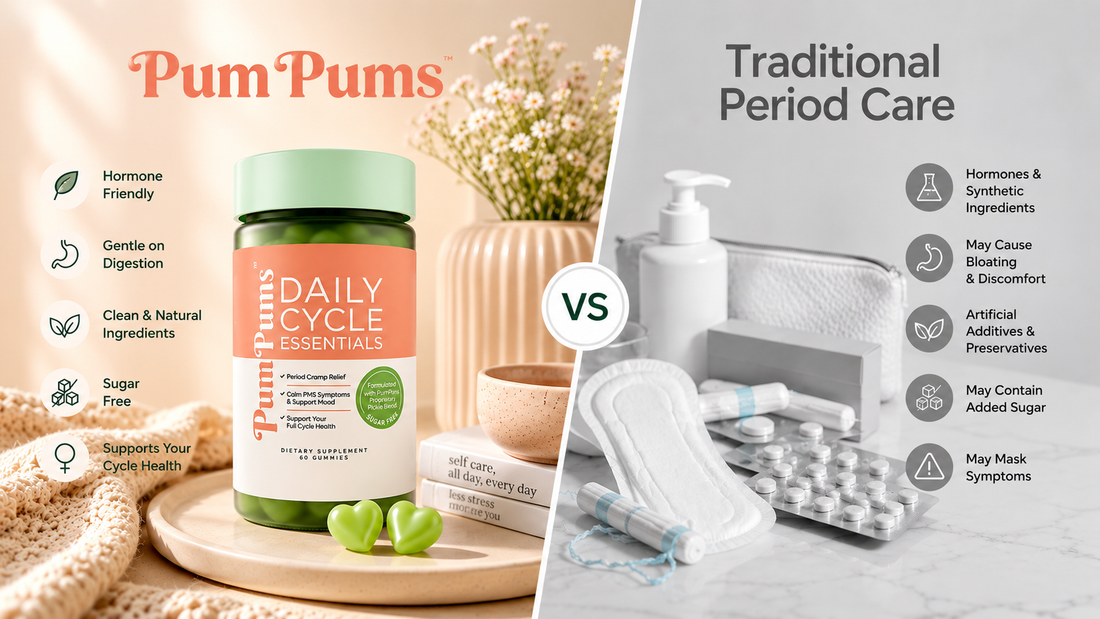
Traditional Period Care vs. A Proactive Daily Approach
Let's compare the two approaches side by side.
Traditional Period Care:
- Reach for pain relievers when cramps start
- Use a heating pad for a few days
- White-knuckle through mood swings and fatigue
- Wait for symptoms to pass and repeat next month
- Treats the cycle as a problem to endure, not a system to support
Proactive Daily Cycle Support:
- Build a consistent hormone-friendly wellness routine all month
- Address the root causes of PMS symptoms: inflammation, nutrient gaps, stress response, and hormone fluctuation
- Support digestion and reduce bloating before it becomes uncomfortable
- Give your nervous system daily tools to regulate mood and stress
- Enter your period with your body already supported, not depleted
More women across the US are choosing the second path, and it's changing how they experience their entire month, not just their period week.
What Helps PMS Symptoms Naturally? Building a Hormone-Friendly Routine
When women search for what helps PMS symptoms naturally, the most evidence-backed answers point to consistent nutritional and lifestyle support. Key areas include:
- Magnesium is one of the most studied minerals for menstrual health. It plays a role in muscle relaxation (hello, cramp relief), mood regulation, sleep quality, and reducing water retention that contributes to bloating.
- Vitamin B6 supports serotonin synthesis, which is directly connected to mood stability and the emotional symptoms of PMS.
- Chasteberry (Vitex agnus-castus) is a well-researched herb with a long history of use for hormone balance support, particularly in regulating the luteal phase and reducing PMS severity.
- Dong Quai provides traditional herbal support for uterine health and menstrual regularity, often used for cycle irregularities and heavy periods.
- Omega-3 fatty acids offer anti-inflammatory support that can reduce prostaglandin-driven cramping and improve mood.
- Adaptogens like ashwagandha help regulate the cortisol-hormone relationship, making your cycle less vulnerable to the effects of stress.
Beyond supplements, sleep, gentle movement, reduced sugar intake, and hydration all play measurable roles in how your hormones behave each month. A hormone-friendly wellness routine layers these pieces together rather than relying on any single fix.
Introducing a Smarter Kind of Period Care Essential
This is exactly the gap that PumPums Daily Cycle Essentials was designed to fill.
Rather than offering a one-time cramp remedy, PumPums Daily Cycle Essentials is built for the full twenty-eight-day cycle — because that's how long your hormones are working, whether you're paying attention or not. It's crafted as a daily supplement formulated to support the hormone balance, energy, mood, and comfort that women need throughout every phase of their cycle, not just the days they're bleeding.
For busy women who don't have time to stack eight different supplements or rebuild their entire lifestyle overnight, PumPums offers a practical, accessible entry point into proactive menstrual health supplements — the kind of daily foundation that works quietly in the background so you can show up as your full self every week of the month.
PumPums Daily Cycle Essentials is designed to support:
- Natural cramp relief and reduced menstrual discomfort
- Mood and emotional balance during PMS
- Energy and reduced cycle-related fatigue
- Bloating and digestive comfort throughout the cycle
- Hormone balance and regularity support
- Stress resilience so cortisol doesn't hijack your cycle
Shipped directly to your door anywhere across the United States, it's period care essentials made for women who want more than just survival mode.
The Growing Menstrual Wellness Movement in the US
Something significant is shifting in how American women approach their reproductive health. Across the country, women are moving away from the "just push through it" mentality and toward genuine, informed self-advocacy.
Search trends for women's hormone health, best supplements for PMS, and menstrual cycle support have grown dramatically over the past few years. Women in their twenties, thirties, and forties are reading about their cycles, tracking their phases, and seeking out daily supplements for menstrual wellness that treat them as whole people, not just symptom-management cases.
This movement is driven in part by a growing awareness that PMS is not inevitable in its severity. That heavy periods and debilitating cramps are worth addressing. That cycle irregularities can signal underlying hormone imbalances worth paying attention to. And that period support for women shouldn't be limited to a box of pads and a bottle of Midol.
Women are investing in their health proactively — and the market for women's hormone support supplements online USA is growing because women are demanding better options. PumPums was born from that same conviction: that every woman deserves to feel supported throughout her entire cycle, every single month.
Your Cycle Deserves More Than Just Surviving
You deserve to feel good for more than one week out of every four. You deserve to go into your period week supported — not depleted, not dreading it, not already running on empty. You deserve mood support during PMS that actually works, natural cramp relief that doesn't require you to abandon your day, and the kind of daily foundation that lets your hormones do their job without working against you.
That's what proactive menstrual cycle support looks like. Not a magic fix. Not a replacement for medical care when it's needed. But a consistent, thoughtful daily routine that honors the full complexity of your body and your cycle.
Start supporting your hormones, your energy, your mood, and your cycle — every day of the month.


