
Compartir
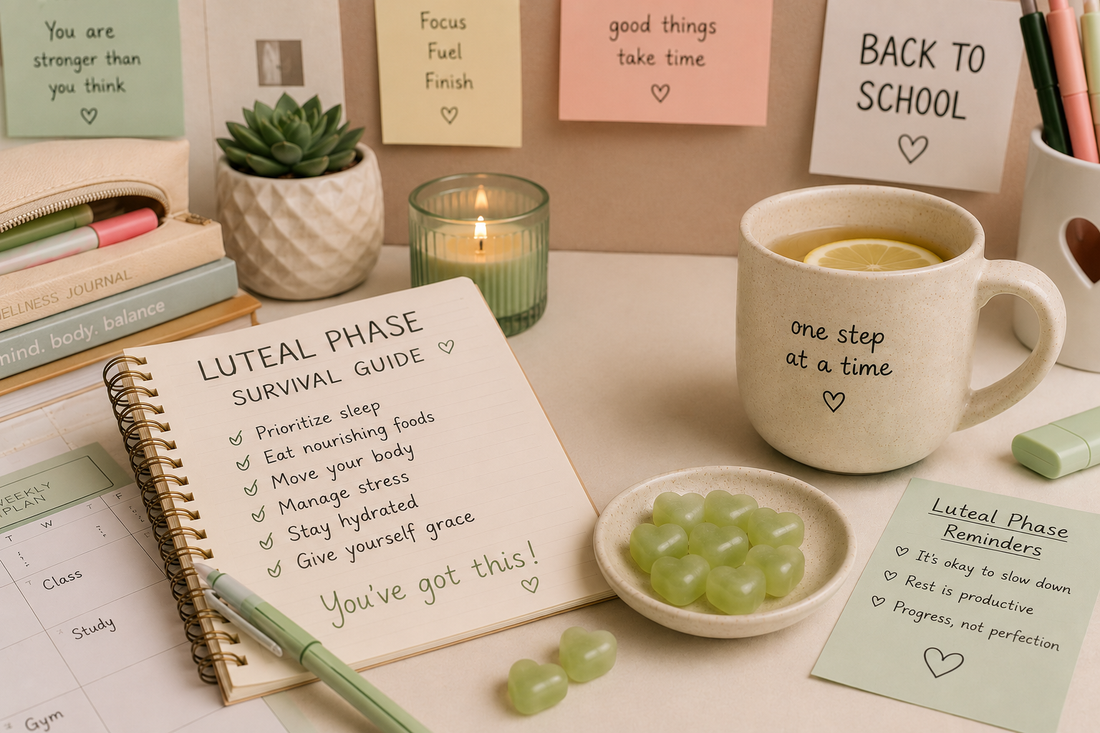
Back-to-school season piles new routines, schedules, and mental load right on top of the two weeks each month when your body is already more reactive to stress — the luteal phase. Understanding why this collision feels so intense, and having a few targeted strategies ready, can make the transition noticeably more manageable.
If the start of the school year has ever left you feeling unusually snappy, teary, or overwhelmed, timing might be part of the story. September routines don't check your calendar before arriving — and if they land during your luteal phase, the stress hits differently.
Why New Routines Hit Harder During the Luteal Phase
The luteal phase — roughly the two weeks between ovulation and your period — is when progesterone rises and then, along with estrogen, drops sharply just before menstruation begins. This hormonal shift affects neurotransmitter activity in ways that are now fairly well documented in research on stress reactivity across the cycle.
Studies looking at cortisol response to stress across the menstrual cycle have found greater stress reactivity during the luteal phase, meaning your body may respond more intensely to a given stressor even when your baseline cortisol looks normal. In other words, it's not that you're "more stressed" in a general sense — it's that your nervous system reacts more strongly to the same amount of stress during this window. Research specifically on premenstrual syndrome has found that women with PMS show altered stress response patterns compared to those without it, and women with more severe premenstrual symptoms (PMDD) show particularly strong shifts in stress reactivity in the days right before their period.
Layer back-to-school chaos on top of that — new schedules, school supply runs, packed lunches, homework routines, after-school activity logistics, and the general mental load of a household transition — and you get a collision of heightened biological stress sensitivity and genuinely higher external demands. It's a real, physiologically grounded reason this season can feel disproportionately hard, not just a scheduling inconvenience.
5 Practical Luteal-Phase-Friendly Back-to-School Strategies
- Front-load the logistics before your luteal phase, if you can predict it. If you track your cycle, try to knock out school shopping, form-filling, and schedule coordination during your follicular phase (right after your period), when energy and stress tolerance both tend to be higher.
- Protect sleep aggressively during the transition. Sleep disruption compounds stress sensitivity in the luteal phase, and new school-year wake times often mean less sleep for the whole household. Adjust bedtimes gradually in the week before school starts rather than all at once.
- Build in a 10-minute decompression window daily. Even a short buffer — parking in the driveway for five extra minutes, a quiet cup of tea before the after-school pickup rush — gives your nervous system a chance to reset between stress spikes.
- Simplify where you can, especially in the two weeks before your period. This isn't the season to also start a new fitness challenge or overhaul your meal plan. Save the ambitious projects for your follicular phase and keep luteal-phase goals modest.
- Name it out loud, to yourself and your household. Simply recognizing "this is a heightened-reactivity week for me, on top of a genuinely chaotic week for everyone" can reduce the shame spiral that often follows snapping at your kids or partner over something small. If this transition affects your relationship, explaining cycle-based mood changes to your partner can help them show up for you during this specific window instead of taking it personally.
Pair This With a Luteal-Phase Ritual
Rather than white-knuckling through back-to-school season, build in a small, repeatable ritual that specifically targets luteal-phase stress physiology. Our guide to the cortisol cocktail for PMS and the luteal phase walks through a simple, evidence-informed morning or afternoon ritual designed to support stress balance during exactly this hormonal window — a useful five-minute anchor to add to an otherwise chaotic September routine.


